VeraTeach
Live · Web · K–12
An AI teaching workspace that carries a lesson from standards through Google Classroom to returned grades.
I designed and built VeraTeach end to end — strategy, positioning, the AI architecture and the systems underneath — built first for middle- and high-school teachers, with the teacher in control at every step.
The short version
A crowded category competes on what AI can generate. VeraTeach competes on the workflow around it — grounding, materials, publishing and grading in one workspace, with AI drafting and the teacher deciding.
- Role
- Founder / AI Product Builder, Yellow Labs Products
- Timeline
- June 2026 – present
- Status
- Live at verateach.com · self-serve
- Live
- verateach.com ↗
Key signals
- Grew from a lesson planner into a planning → Google Classroom → grading loop
- Retrieval grounded in 110,000+ standards records across 185 frameworks in 17 states
- AI cost of about $1 a month for a heavy teacher, against a $4–8 planning estimate
Capabilities shown
- Product strategy
- Positioning
- Workflow design
- Pricing & business model
- Retrieval & grounding
- Evaluation & model routing
- Human-in-the-loop
- Measurement
How it was built · I use AI-assisted development to work directly in the implementation layer, while owning the product decisions, architecture, evaluation criteria and production validation.
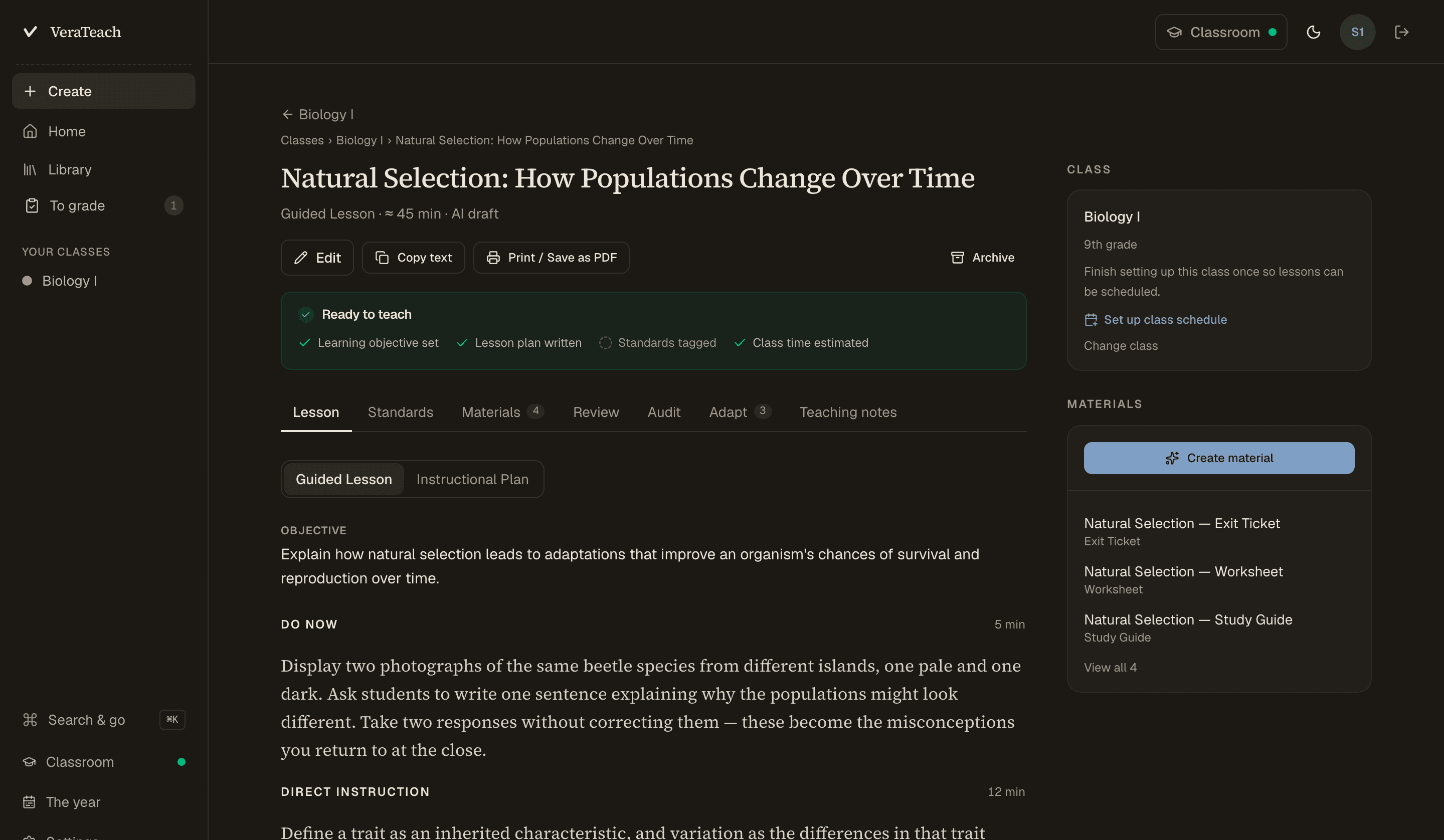
Every handoff in a teacher’s week is manual re-entry.
A teacher’s week is spread across disconnected tools: one place to plan, another to look up standards, another to build the quiz, Google Classroom to hand it out, a spreadsheet to grade it. Each handoff is manual re-entry. Most AI tools for teachers generate a document and stop, dropping it into the middle of a workflow they don’t participate in.
How the product found its shape.
Several kinds of input shaped VeraTeach, and they carry different weight: conversations with teachers, structured walkthroughs of the product against real teaching tasks, a competitive scan, and — once it was live — how people actually used it.
Compete on the workflow, not the feature count
A competitive scan of MagicSchool, Brisk, Khanmigo, Curipod and Diffit showed the category racing on breadth, time-saved claims and trust badges — a race a new product can’t win. The positioning work aimed to change the axis of competition instead: a persistent planning workspace, quality that can be shown, and depth on standards rather than breadth.
Walkthroughs found what the roadmap missed
Walking the product through real teaching tasks before pilots produced a batch of changes: a preview step was cut so generated lessons save directly, adapting a lesson moved onto the Home screen where a teacher starts the day, coaching-style review was split from scored audit, and a setting that could silently delete lessons was removed.
Teacher input, in the details
Conversations with teachers informed the product throughout. One documented example: lessons carry a movement attribute because a teacher described “my after-lunch group — they need to be up and moving.”
What the product became
The first product vision explicitly ruled out LMS integrations, student-facing pages and billing. Each was added once the workflow made the case for it.
- 01
Planning
A lesson starts inside real structure — course, class, standards — not a blank prompt box. Teachers can write guidance that shapes generation before it runs, or import material they already have.
- 02
Grounding in standards
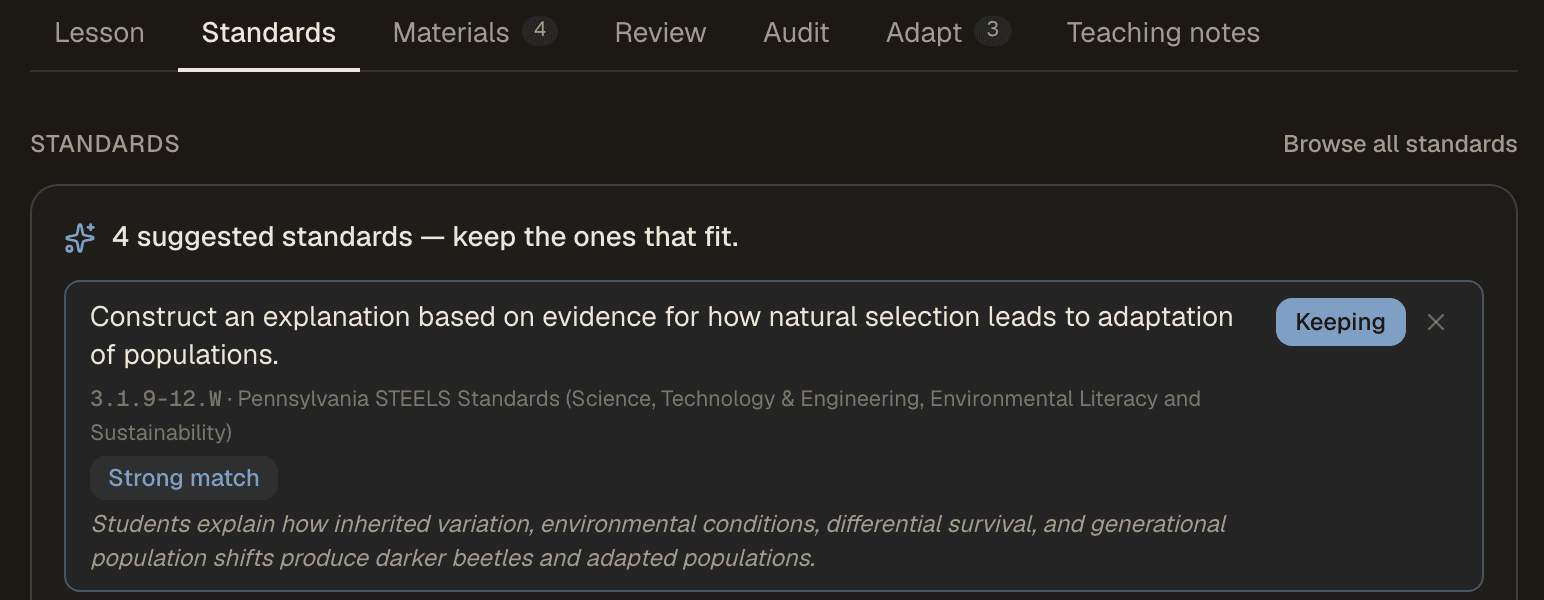
Retrieval grounds the lesson in state standards, so alignment is verifiable rather than asserted.
- 03
Review & adaptation
Standards-aware review checks the lesson before it’s taught, and one lesson adapts — shortened block, substitute, ELL — without losing its objective.
- 04
Materials
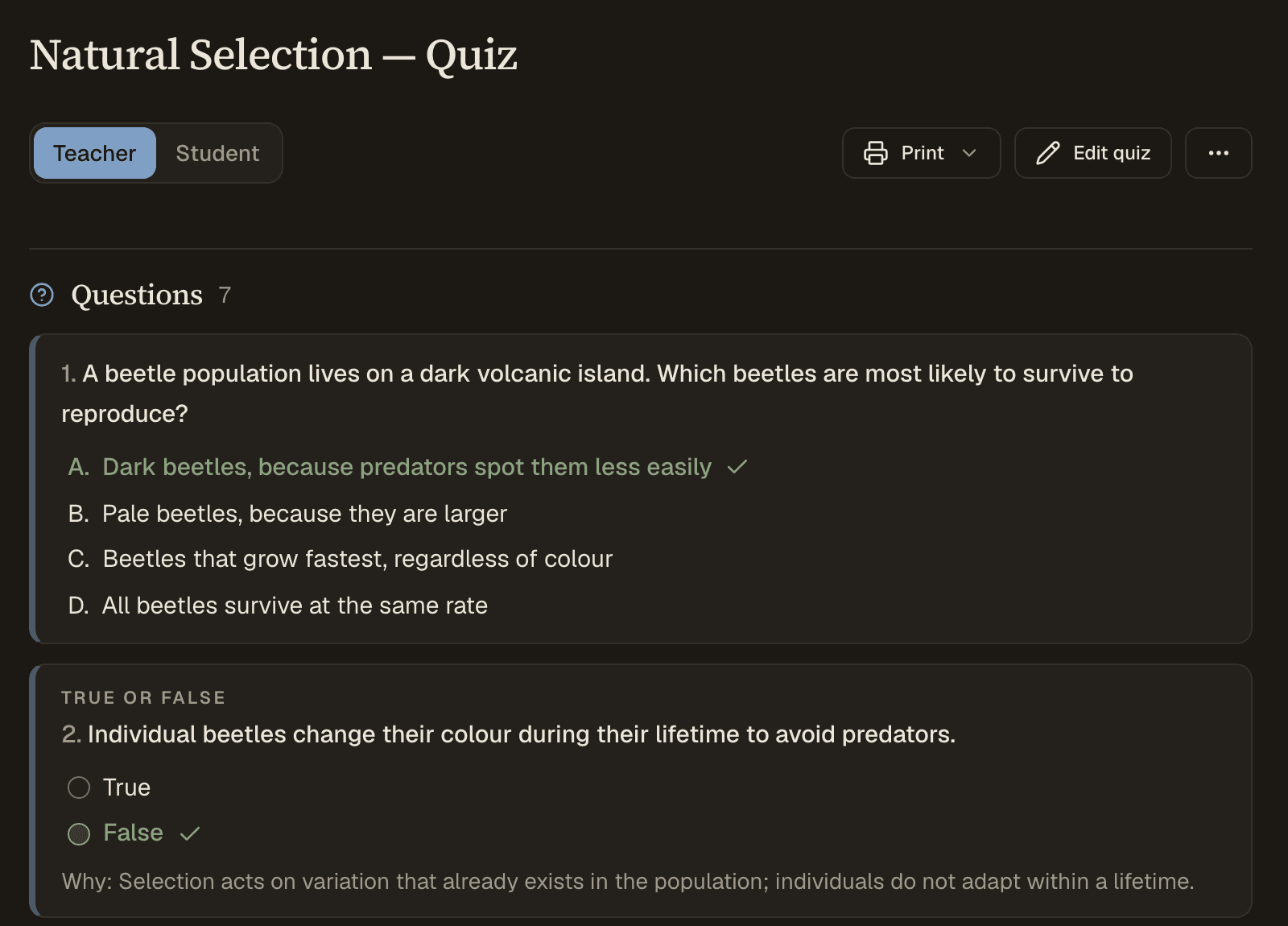
Quizzes, tests, worksheets, study guides, exit tickets and handouts generate from the lesson as editable assets the teacher can rewrite.
- 05
Publishing
A material publishes into Google Classroom — as a native Google Form where it’s an assessment, or as a Doc or live link where it isn’t.
- 06
Grading
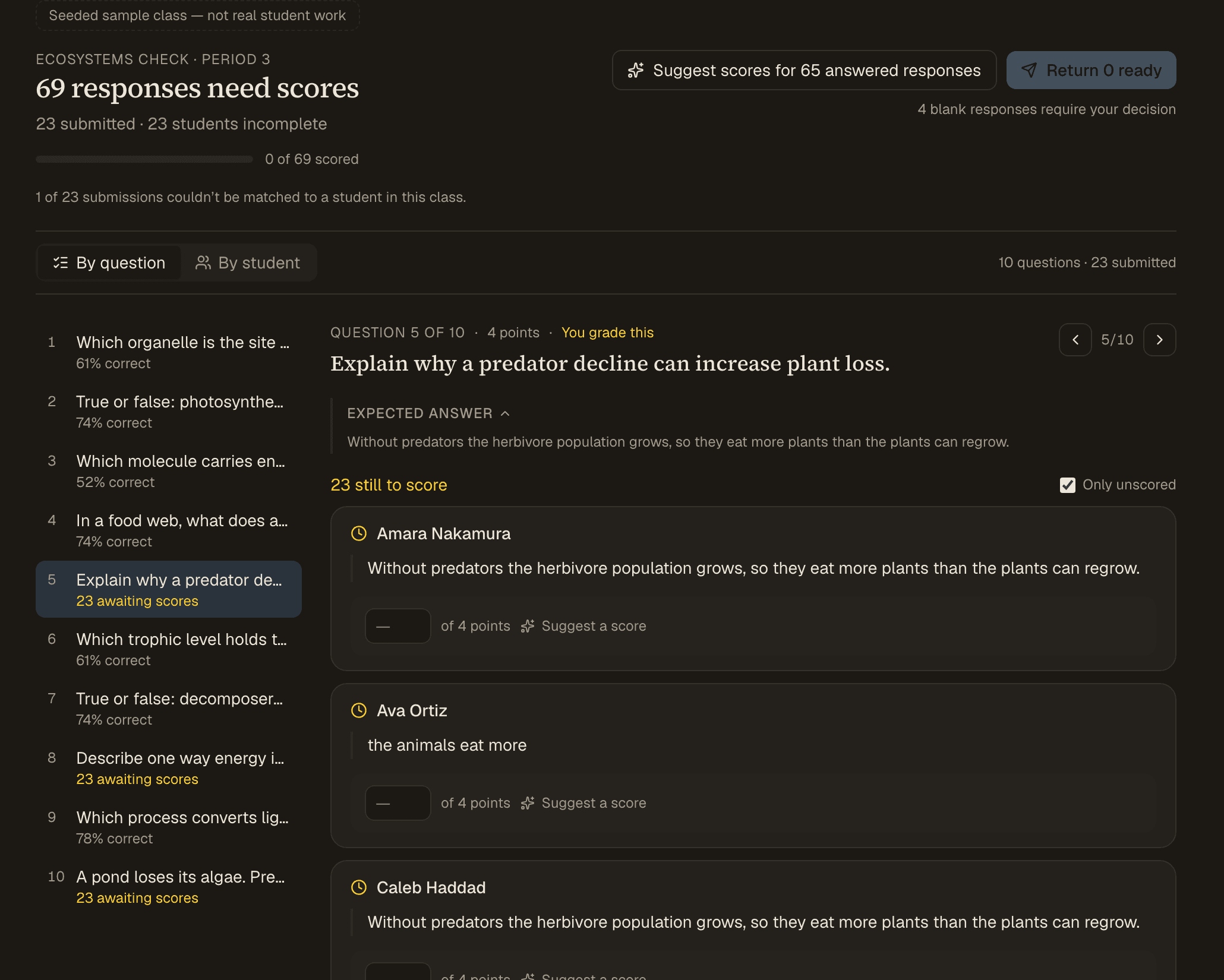
Submissions come back into a grading workspace. Objective questions score automatically; written answers get AI-drafted suggestions the teacher accepts, edits or ignores.
- 07
Returning grades
Approved scores go back to Google Classroom, closing the loop inside the tool the school already runs on.
The tradeoffs I made on purpose.
AI suggests the grade; the teacher gives it
Objective questions score themselves. For written work the model drafts a score and rationale and stops there — it can decline with “needs teacher judgment,” and never sees student identity. Grading is a judgment a teacher answers for; automating it would move accountability to something that can’t hold it.
Preparation, not delivery
VeraTeach could have drifted into becoming an LMS. Instead it prepares, publishes and grades, while Google Classroom stays the system of record schools already run on — which is also why the Workspace Marketplace listing was pursued for district admin allowlisting rather than discovery.
Correctness over coverage
A broader search would surface more standards. Retrieval stays bounded and the model abstains rather than padding the list, because in a standards-aligned product a confidently wrong suggestion is worse than a narrower right one.
Own the corpus rather than the integration
Licensing a standards API would have been faster. Owning the ingestion means alignment is verifiable, adding a state costs days rather than a negotiation, and no vendor sits between a teacher and whether their lesson is correct.
Pricing that never punishes a downgrade
Plans launched as hypotheses, not convictions. Downgrading deletes and locks nothing, and pricing copy was corrected whenever it promised something enforcement didn’t. When an early free plan turned out to allow a complete, forever-free workflow, limits were reset so free stays useful without replacing paid. The launch offer was a one-time discount, not a price, so it couldn’t quietly become permanent.
Retire what the evidence doesn’t support
Letting visitors generate a lesson before signing up was built to lower the barrier to trying the product. The data showed it wasn’t converting and was the only unmetered AI spend, so it was retired in favor of signing in first and starting immediately after.
AI as orchestration, not a single call.
The interesting decisions aren’t which model to call. They’re how retrieval, generation, routing and approval fit together so the system stays correct, affordable and accountable at every step.
Grounded standards retrieval
A hard filter on state, subject-eligible frameworks and grade; vector similarity over the embedded standards; then an LLM rerank that can only choose from the retrieved candidates, with a confidence gate that abstains when nothing is a strong match. Results are cached against the corpus, model and prompt versions.
A corpus worth retrieving from
I built and maintain the corpus itself — 185 frameworks across 17 states, 110,000+ records — ingested from each state’s own documents, every one with its own format and parsing failures.
One execution layer for every AI call
Generation, review, adaptation, materials and grading suggestions all run through a single layer that enforces a typed schema and a timeout, and records model, latency, tokens and cost for every call — which is where routing and cost decisions get their data.
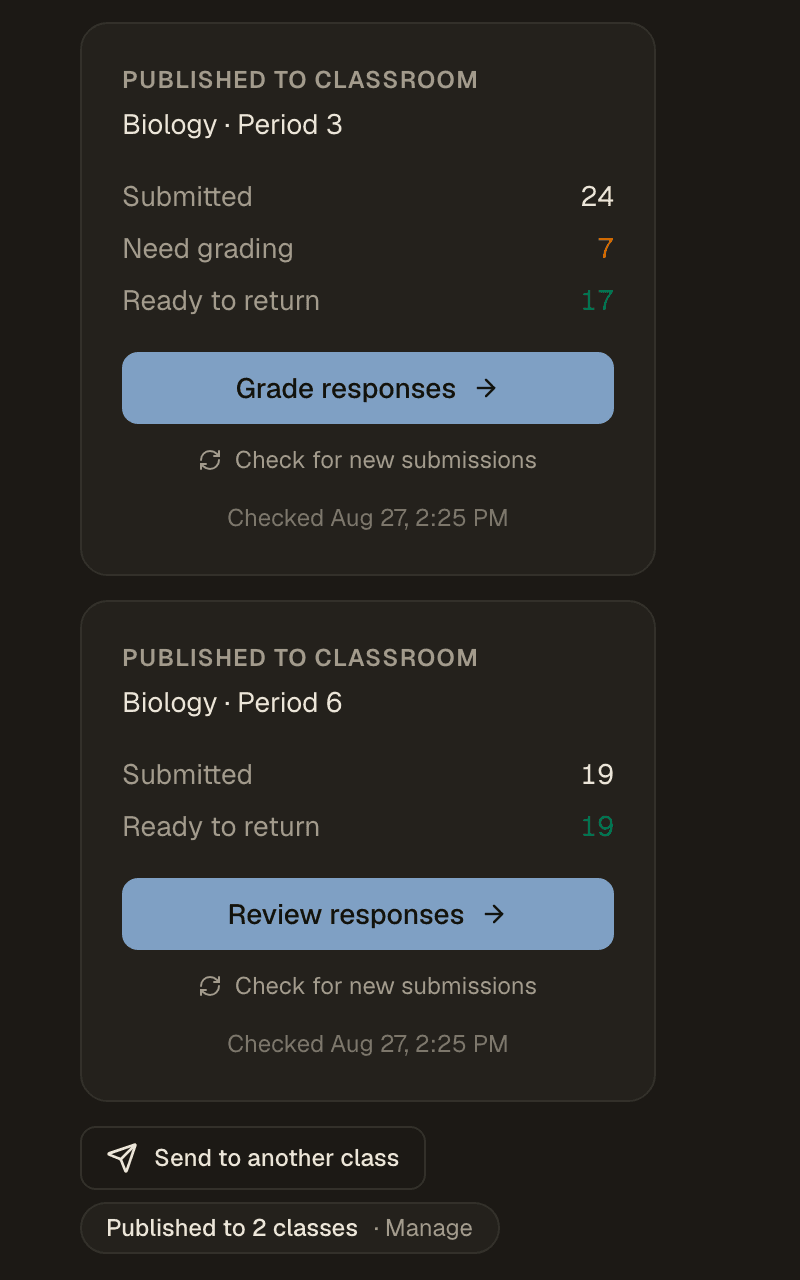
The loop closes back inside Classroom
Publishing creates a real Google Form in the teacher's own Classroom and maps every question, so submissions come back per class and hand off to grading. Re-publishing is idempotent, and only teacher-authored scores are ever returned. That round trip — not the export — is what makes this usable on a Tuesday.
For technical readers · Architecture & stack
The stack supports the product decisions above; it isn't the story.
- Stack
- Next.js 16React 19TypeScriptSupabase / PostgresVercel
- Data & standards
- pgvector (exact cosine)text-embedding-3-smallPer-state ingestion and verificationAppend-only, trigger-written versioning
- AI orchestration
- One execution seam for every generative callTyped schemas and per-attempt timeoutsStakes- and cost-based routing via AI GatewayPreview-first, teacher-approved writes
- Google Classroom
- Verified OAuthPersistent period → course mappingNative Google Forms quizzesIdempotent re-publishResumable grade return
- Performance work
- Standards reranker 12.6s → 1.8s at 6.4× lower costVector query rewritten: cold latency 177ms → 27msStandards picker moved to a trigram index (searches had taken 1–7s)
- Production
- Stripe subscriptions and usage entitlementsPer-call AI usage and cost eventsFunnel events, alerting and a daily canaryError monitoring
- Key systems
- Standards retrieval (filter → vector → constrained rerank)Library search (keyword + vector, RRF)Assessment → publish → grade → return loopLesson import from existing materialCopy-on-write scheduled instances
You can’t ship AI you can’t measure.
Shipping AI teachers can trust means measuring quality deliberately — and treating cost and latency as product decisions, not afterthoughts.
Rubric evaluation
Lessons are scored on eight explicit criteria, from objective clarity to teacher usability, and any evidence the evaluator cites must appear verbatim in the lesson, or it is dropped.
Blind model comparison
Model and prompt variants are compared blind, with output order shuffled, on quality, latency and cost. On generated tests, a three-way comparison found equal quality at ~33% lower cost and set the routing for summative assessments; low-stakes materials run on a model roughly 10× cheaper per token.
A measured model change
Moving rubric evaluation to a cheaper reasoning model cut it from 74s to 19s at ~2.1× lower cost, with a mean score difference of 0.05 on a 0–4 scale across a fixed lesson set.
A benchmark that rewarded the wrong thing
One evaluation benchmark turned out to reward confident invention over asking a clarifying question. I changed the benchmark before trusting its results.
Regression, retrieval and corpus checks
Live checks run against real models when a prompt or model changes, across a baseline matrix of K–12 subjects and grades. Retrieval recall is benchmarked, and every standards framework passes coverage checks against its source before teachers see it.
Live, self-serve, and measured.
VeraTeach is live and self-serve: a teacher can sign up, connect Google Classroom and start without talking to me. Getting there was as much product work as engineering.
- Google OAuth verification approved for Classroom and Forms — the long pole to launch
- Free and paid plans with usage entitlements, set as hypotheses to revisit
- AI cost measured per call: about $1 a month for a heavy teacher, against a $4–8 planning estimate
- A durable funnel-event table and alerting, so the funnel is measurable rather than inferred
- Onboarding reworked so a new teacher reaches a first lesson before being asked to set anything up
Decisions the evidence changed.
Measurement before optimization
When traffic wasn’t converting, I investigated before changing the page: most catalog “views” turned out to be bots, and real visitors were largely mobile ad clicks looking for things the catalog didn’t cover. The first fixes were to the measurement, not the product.
Two fast reversals
A unit-first homepage was reverted the same day, once it was clear it met lesson and quiz searches with a page about something else. A landing change that stopped ad signups was rolled back within two days.
A silent failure, made loud
Every creation path once failed for about 14 hours behind a friendly error message that no monitoring saw. The lesson: a user-visible failure that degrades gracefully is invisible to every system you run — so alerting now watches what users experience, not just crashes.
Generating a lesson was never the hard part; a model does that in seconds. The product is everything around it — the standards corpus, the Classroom round trip, the grading loop, a business model that doesn’t punish teachers — and the discipline to measure which of those choices actually work.
What I’d measure next.
The product works in production today. These are the next layers of measurement and rigor I’d add as it matures.
- 01Run the properly powered landing-page experiment the conversion analysis specified, rather than iterating on a sample too small to read.
- 02Run the live evaluation suite automatically on every prompt or model change, rather than on demand.
- 03Build an expert-labeled standards gold set, so retrieval recall is measured against teachers’ judgment rather than a full-pool model baseline.

